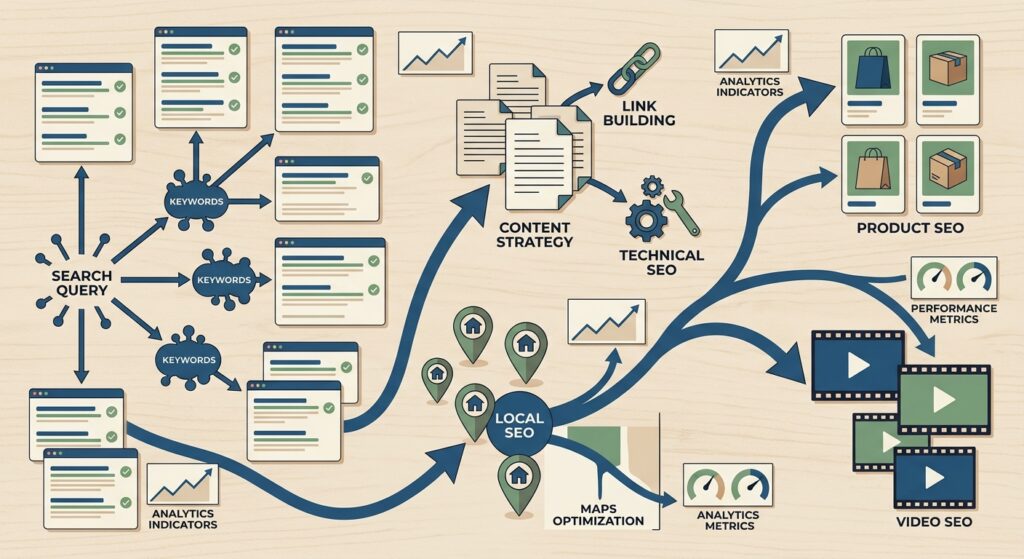
Traditional rank tracking answers a narrow question: where does a URL appear among organic listings? It does not explain whether the result page gives the searcher a direct answer, pushes commercial results below the fold, surfaces local businesses, invites product comparison or sends attention to video, images and AI-generated summaries.
That is why seo serp feature optimisation needs an opportunity map rather than a list of keywords. The map connects a query cluster to the features present in its live results, the intent behind those features, the asset or technical work needed to compete, and the commercial value of winning visibility.
The practical objective is not to chase every feature. It is to find situations where your business can provide the format Google or Bing is already rewarding, while still helping a qualified prospect take the next step. In my experience, this prevents teams from investing in schema or content templates simply because they are fashionable.
Start with the result page, not a feature checklist
SERP features are result formats beyond standard organic links. Depending on the query, they can include featured snippets, People Also Ask questions, local packs, product results, image packs, video carousels, sitelinks, knowledge panels and AI-generated answer experiences. Their availability changes by location, device, query wording and time.
Do not treat a feature as a permanent entitlement. Search engines choose presentation dynamically. Google’s own Search documentation is the appropriate reference for implementation guidance, but structured data or technically valid pages do not guarantee a rich result or a particular placement. That distinction matters when setting stakeholder expectations.
Build the map from actual observed results. For each priority query, record the desktop and mobile SERP, target geography, date, features shown, domains appearing, and whether your site already appears. A manual review works for an initial strategic set; a rank-tracking platform can make recurring collection manageable. Preserve screenshots for high-value terms, because a raw feature label rarely conveys how much visual space it consumes.
Build a query inventory around demand and intent
Begin with Search Console queries and landing pages, internal-site search, sales-call language, paid-search terms, customer questions and competitor topic coverage. Group close variants into clusters rather than creating one row for every spelling or word order. The unit of planning should be an intent-led topic, with representative queries beneath it.
Then label the dominant intent. A useful working model has five categories:
- Know: definitions, explanations, symptoms and how-to questions.
- Compare: alternatives, costs, best options, reviews and specifications.
- Do: calculators, templates, downloads, bookings and configuration tasks.
- Go local: near-me, service-area, branch and location searches.
- Buy: product, category, availability and transactional terms.
Intent should be based on the results, not merely a keyword modifier. “Best payroll software” may produce editorial comparisons, product pages and video reviews. That mixed page calls for a different asset than a pure category query. Record the evidence: types of ranking pages, recurring feature formats and whether the query asks for an answer, a shortlist or a provider.
If your customer understanding is weak, use a search-led research process before expanding the inventory. This guide to building a search-led customer insight system is useful for turning recurring query patterns into sharper content and offer decisions.
Create the SERP feature opportunity map
A spreadsheet is sufficient at first. The discipline lies in the fields, not the software. Each row should represent a query cluster-feature combination. A single cluster may create separate opportunities for a featured snippet, video result and People Also Ask coverage, but do not assume all deserve distinct work.
| Field | What to capture | Decision it supports |
|---|---|---|
| Query cluster | Representative query, variants, market and device | Defines the demand being assessed |
| Intent and stage | Know, compare, do, local or buy; awareness through decision | Tests fit with the offer and page type |
| Observed feature | Feature, occupying domains and visual prominence | Shows the format currently rewarded |
| Current position | Your URL, feature appearance, impressions and clicks | Separates defend, improve and create work |
| Required asset | Guide, comparison table, product feed, video, local page or FAQ section | Creates a clear delivery brief |
| Dependencies | Data accuracy, imagery, reviews, schema, templates, feeds or engineering | Reveals delivery risk |
| Business value | Conversion relevance, margin, lead quality and strategic importance | Prevents volume-only prioritisation |
Use a separate notes column for negative evidence. For example: “product carousel is dominated by merchants with complete feeds; our stock data is unreliable” or “local pack is outside our service area.” A credible map makes disqualification visible. It is as valuable to stop poor work as it is to identify promising work.
Map feature requirements to content and technical reality
Features are not interchangeable. A featured snippet opportunity usually requires a page that answers the question plainly and supports the answer with useful context. A product result depends on accurate commercial data and eligible page markup. A local pack is influenced by relevance to the local query and the quality and consistency of local business information, among other signals. The right response is to match the format, not paste FAQ schema across the site.
Answer-led features: snippets, follow-up questions and AI discovery
For explanatory queries, create a concise answer near the relevant heading, followed by steps, caveats, examples and sourceable detail. Use descriptive headings, logical lists where a process is genuinely sequential, and tables where comparison is the job. The answer should stand on its own without becoming so abbreviated that it misleads.
People Also Ask is particularly useful research material. Capture recurring questions, group duplicates and address them within a strong primary page when they share the same intent. Split them into separate pages only when the searcher needs a materially different answer or action. This approach also makes content easier to quote and interpret in answer-engine contexts, though no page format guarantees inclusion in an AI answer.
For a broader view of visual, voice and AI discovery formats, see this multimodal search optimisation framework.
Commerce features: products, pricing and comparison
Commercial feature opportunities demand operational accuracy. Check that price, availability, product identifiers, variants, images, delivery details and returns information agree across the page and any feed. A comparison page should state its selection criteria, update date and meaningful differences rather than manufacture a superficial “versus” page for every competitor.
Structured data can help machines interpret eligible information, but it is not a substitute for visible, accurate content. Validate implementation, monitor errors and assign an owner to product-data changes. Bing’s Webmaster resources can complement Google data when Bing is relevant to your audience.
Local, image and video features
Local opportunities require accurate business details, appropriate location pages, evidence of service coverage and a process for maintaining reviews and listings. Do not create thin city pages for places you cannot genuinely serve. For image and video features, the asset has to answer the query: clear original visuals, descriptive surrounding copy, useful video titles and a page that explains why the media matters. Treat accessibility text and metadata as supporting context, not a magic switch.
Score opportunities by impact, confidence and effort
Search volume is an input, not the verdict. A low-volume “book emergency boiler repair” cluster may be worth more than a broad informational term if it has strong conversion intent, healthy margins and a realistic path to visibility. Conversely, a large featured-snippet opportunity can generate attention without moving a meaningful business metric.
I recommend a simple 1–5 score for four dimensions: business value, visibility potential, confidence and effort. Business value reflects conversion relevance and economics. Visibility potential considers feature prominence, query demand and your current competitive footing. Confidence measures the evidence that the proposed asset matches the observed intent. Effort includes production, approvals, engineering and ongoing data maintenance.
Calculate a working priority score as: (business value × visibility potential × confidence) ÷ effort. It is not a forecasting model. It is a transparent way to compare choices and expose disagreements. If a leadership team thinks a local opportunity is strategically vital, increase its business-value score openly rather than pretending the decision came from keyword volume.
Apply a feasibility gate before committing work:
- Can the business substantiate the claim, price, availability or location information?
- Is there an existing URL that can be improved without creating cannibalisation?
- Can the required data and markup be maintained after launch?
- Does the feature route users toward an appropriate next action?
For engineering-dependent items, convert the map into a short business case with scope, risk and measurement plan. The process in this SEO business case framework for engineering teams helps turn an SEO request into a decision-ready brief.
Turn priorities into deployable experiments
Each chosen opportunity needs an owner, a defined URL, an asset specification, dependencies, launch date and review window. Keep the first cycle deliberately narrow: a small number of high-confidence clusters is easier to learn from than a site-wide rewrite.
For example, a B2B software firm might prioritise a comparison cluster that produces editorial lists and follow-up questions. The plan could be one evidence-led comparison page, improved product pages for named alternatives, a short demonstration video and internal links from related guides. The measurement hypothesis is not “we will rank first.” It is “a clearer comparison asset may increase qualified impressions, feature presence, organic visits and demo starts for this cluster.”
Record a baseline before publishing. Include query-level impressions, clicks, CTR, average position as directional context, landing-page conversions, assisted conversions where available, and current feature ownership. Annotate releases in analytics and Search Console exports. If several changes go live together, be candid that clean attribution becomes harder.
Measure visibility, clicks and conversion quality beyond rank
A SERP feature map should feed a monthly view with three layers. First, visibility: share of tracked query clusters where the target feature appears, your presence in that feature, impressions and visual prominence notes. Second, engagement: clicks, CTR and landing-page behaviour segmented by cluster, device and country. Third, business outcome: form starts, qualified leads, bookings, sales, revenue where tracking is reliable, and downstream quality signals such as sales acceptance.
Interpret CTR carefully. Winning a direct-answer feature can raise impressions but reduce clicks when the query is fully answered on the results page. That is not automatically failure. Assess whether the cluster is strategically useful, whether branded searches change, and whether commercial next steps improve. For transactional terms, a decline in clicks deserves more scrutiny than it might for a basic definition.
Use control groups where practical: comparable clusters or pages not changed during the review period. Look for sustained patterns rather than reacting to a few days of movement. Also inspect the live SERP again. A shift may reflect a new feature layout, seasonality, competitor change or tracking geography—not solely your work.
FAQ and conclusion
How often should a SERP feature opportunity map be updated?
Review priority commercial and local clusters monthly, and refresh the wider map quarterly. Update sooner after a major site release, feed change, new location or clear shift in search demand. The live SERP is the source of truth; old feature labels become stale quickly.
Does schema markup guarantee a rich result?
No. Valid markup can help search engines understand eligible content, but it does not guarantee display, position or clicks. Treat it as one implementation requirement, then verify visible page quality, data accuracy and search-result behaviour.
What is the best first feature to target?
Choose the feature where existing intent, your evidence or inventory, and a commercially sensible next action overlap. For many service businesses, that may be a local or comparison opportunity rather than a high-volume informational snippet.
Conclusion: A useful opportunity map makes SEO SERP feature optimisation operational. Observe the result page, classify intent, specify the required asset and dependencies, score the business case, and measure visibility alongside qualified outcomes. It will not remove uncertainty from search, but it gives marketing, content and engineering teams a shared basis for deciding what deserves effort next.