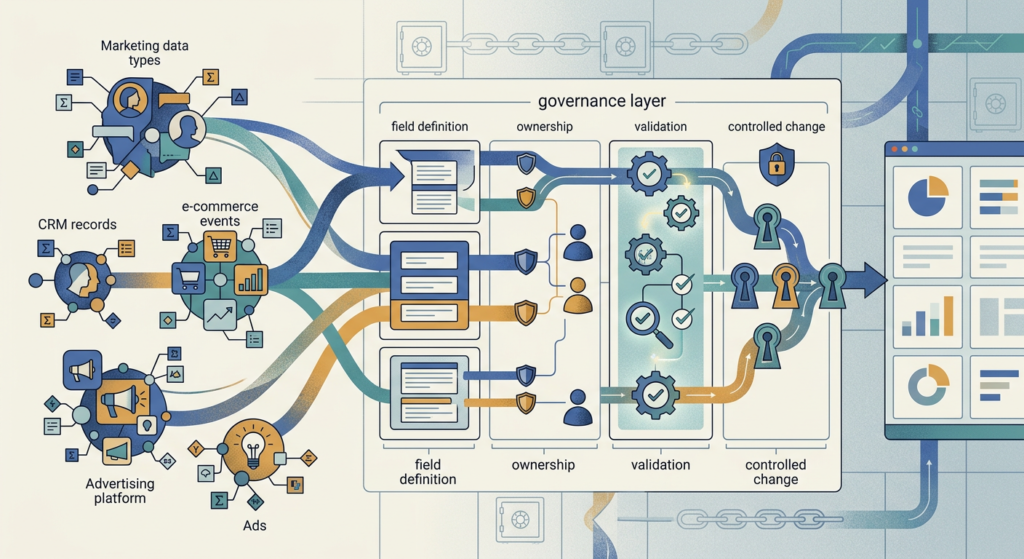
Cross-channel reporting breaks down for predictable reasons. The CRM calls a qualified lead an MQL, the ad platform calls it a conversion, and the analytics property records an event with a different name or missing campaign context. Each system may be working as configured. Together, they create reports that cannot answer a basic commercial question: which activity created revenue?
A marketing data contract is the operating agreement that prevents this drift. It defines the fields, meanings, formats, owners, validation rules and change process shared by your CRM, website analytics, marketing automation tools and advertising platforms. It is not simply a tracking plan, a spreadsheet of UTM parameters or a dashboard specification. It connects all three.
In my view, the best contracts are deliberately modest at first. Teams often try to document every field in every platform, then lose momentum. Start with the data needed to make material budget, pipeline and channel decisions. Expand once the core flow is stable.
Why a marketing data contract matters
Most attribution disputes are not really attribution-model disputes. They are definition disputes. One report may attribute a sale to last non-direct click, another to a CRM campaign member, while finance recognises revenue only after an invoice or payment event. None is inherently wrong, but they answer different questions.
A good contract makes those distinctions explicit. It gives each metric a stated purpose and source of truth. It also limits the temptation to reconcile incompatible numbers by manually editing reports until they appear to agree.
This becomes more important when conversion signals are sent back to paid media platforms for optimisation. An offline conversion upload or server-side event with weak identifiers, duplicate records or an unclear lifecycle definition can train bidding systems towards the wrong outcome. The issue is operational before it is technical.
A reliable measurement layer also supports the wider planning work in a marketing KPI tree. Teams can connect channel actions to qualified pipeline and revenue only when the definitions between those stages hold up.
Set the contract boundary before defining fields
Begin with a one-page scope statement. Identify the business decisions the contract must support, the systems included, the markets or business units covered, and the lifecycle stages in scope. This avoids a common failure mode: collecting data because it is available rather than because someone will use it.
For a B2B demand-generation programme, a sensible first boundary might include website forms, CRM leads and contacts, opportunity creation, closed revenue, web analytics, Google Ads and LinkedIn Ads. For ecommerce, the equivalent may be product views, add-to-cart, checkout, purchase, refunds and customer status.
Write down the questions the contract must answer. Examples include:
- Which campaign and landing-page combinations create sales-accepted opportunities?
- How much qualified pipeline and recognised revenue can be associated with each channel?
- Which conversions are safe to import into ad platforms for optimisation?
- Where do records drop out, duplicate or lose source data?
Do not promise perfect person-level attribution. Consent choices, browser restrictions, cross-device behaviour, offline interactions and long sales cycles create unavoidable gaps. A contract improves consistency and explainability; it does not make uncertainty disappear.
Create a shared field dictionary
The field dictionary is the centre of the marketing data contract. It should be readable by marketing, sales, analytics, operations and engineering. A database schema alone is too technical for most stakeholders; a high-level channel plan is too vague for implementation.
For every field, document the business definition, system name, format, allowed values, collection point, destination, owner, retention expectation and data-quality rule. Distinguish between an identifier and a label. A campaign ID can remain stable when a campaign name changes; a label is useful for people but is not a dependable join key.
| Shared field | Practical definition | Format and example | Primary owner |
|---|---|---|---|
| lead_id | Immutable CRM identifier for a prospect record | String; CRM-generated value | CRM operations |
| client_id or user_id | Analytics identifier used under your consent and privacy design | Platform-specific pseudonymous ID | Analytics owner |
| utm_source | Publisher or traffic source that delivered the visit | Lowercase; google, linkedin, newsletter | Paid and lifecycle marketing |
| utm_medium | Marketing distribution method | Lowercase controlled list; cpc, paid_social, email | Marketing operations |
| campaign_id | Stable internal or platform campaign reference | String; 2025_uk_demo_q3_01 | Channel owner |
| lifecycle_stage | Current commercially defined status of a person or account | Controlled values; lead, mql, sql, opportunity | Sales operations |
| revenue_amount | Contracted or recognised value, explicitly labelled | Decimal plus currency and date basis | Finance systems owner |
For each revenue field, state whether it means booking, invoiced revenue, collected revenue, annual contract value or lifetime value. “Revenue” without a basis is not a usable definition. The same discipline applies to pipeline: document whether it is created pipeline, weighted pipeline or a current opportunity snapshot.
Assign ownership at field level, not department level
“Marketing owns tracking” is too broad to be useful. Marketing may own campaign taxonomy, while sales operations owns lifecycle-stage logic, engineering owns event deployment, finance owns recognised revenue and analytics owns warehouse transformations. A field can have one accountable business owner and several contributing teams.
Use a lightweight RACI model, but keep the contract decisive. Every critical field needs one person or role authorised to approve its definition and changes. That owner does not need to fix every issue personally; they decide what correct means and ensure a response occurs.
Ownership should include service expectations. For example, a campaign owner may correct a naming error before launch, the analytics team may investigate event failures within one business day, and CRM operations may review unmatched opportunity records weekly. This resembles the clarity needed in an SEO service-level agreement: responsibility works best when deliverables, boundaries and response expectations are visible.
Build naming rules people can actually follow
Naming conventions fail when they require people to memorise a fifty-page rulebook. They also fail when they are so loose that “Paid Social”, “paid_social” and “paidsocial” all enter the reporting layer as different channels.
Use a small controlled vocabulary for fields that drive grouping and automation. Define required casing, separators, date syntax, market codes and prohibited characters. Preserve human-readable campaign names, but pair them with stable IDs wherever possible.
A workable campaign naming pattern
A practical structure is market_objective_audience_offer_period_variant, such as uk_demo_finance_guide_2025q3_a. The exact pattern matters less than stable interpretation. “Objective” should come from a short approved list, not free text. If an agency, regional team or AI workflow creates campaigns, give it the same validation inputs rather than relying on a prompt alone.
Keep platform-native campaign names and your internal taxonomy separate when necessary. Ad platforms have their own constraints and may encourage naming patterns that do not fit the CRM. A mapping table is usually safer than forcing every system to use one string.
For search and answer-engine discovery, record landing-page intent and content type where they inform decisions. Do not pretend that every organic or AI-assisted visit has complete referrer context. Google documents aspects of crawling and indexing through Google Search documentation, but search visibility data and CRM outcomes still need careful joining and interpretation.
Define the event and identity flow
The contract should show how a person or transaction travels between systems. Map the sequence from ad click or organic visit through analytics event, form submission, CRM creation, qualification, opportunity and revenue event. Include the keys used at each hand-off.
There is an important trade-off here. Capturing every available identifier can improve matching, but it can also increase privacy, security and operational risk. Collect only what you can explain, protect and use. Agree with your privacy and legal stakeholders on consent handling, access controls, retention and deletion processes. A marketing data contract is not legal advice or a substitute for formal compliance work.
Where a browser identifier cannot be sent to the CRM, a first-party lead ID, hashed email under an approved process, transaction ID or CRM record ID may become the bridge. Document when that identifier is created, whether it can change, and how duplicates are resolved. Never use email address as a casual universal key; people share inboxes, change addresses and submit forms with inconsistent spelling.
Put validation checks where errors first occur
Monthly dashboard reconciliation is too late. By then, a campaign may have spent budget with malformed parameters or a form change may have dropped essential fields for weeks. Validation should occur before launch, at collection, in data movement and in reporting.
| Check | What it detects | Cadence | Action |
|---|---|---|---|
| Required-field check | Missing source, medium, consent state or lead ID | Pre-launch and daily | Block launch or flag records |
| Allowed-value check | Unapproved lifecycle stages or channel labels | Daily | Route to field owner |
| Volume anomaly check | Sudden event, lead or import decline | Daily | Investigate against releases and spend |
| Duplicate check | Repeated lead, conversion or transaction IDs | Daily or per load | Deduplicate before optimisation upload |
| Reconciliation check | Material mismatch between CRM and reporting model | Weekly/monthly | Classify timing, scope or defect |
Set tolerances by metric and workflow rather than chasing exact equality. Analytics sessions, platform clicks and CRM leads operate on different clocks and rules. The useful question is whether a variance is expected, explained and stable. Unexplained changes deserve investigation.
This is where observability thinking helps. The principles in AI workflow observability apply equally to marketing integrations: monitor volume, failure rates, latency, output quality and the consequences of a bad run.
Use formal change management, even for small edits
Tracking changes are production changes. A revised form field, a renamed CRM stage, an altered tag-manager trigger or a new offline conversion can change historical interpretation and automated bidding behaviour. Treating these as casual edits creates silent reporting breaks.
Create a short change request containing the purpose, affected fields and systems, owner, implementation date, test plan, rollback plan and reporting impact. Classify changes as standard, significant or emergency. A standard approved UTM value may need only a logged request. Redefining “qualified lead” should require sign-off from marketing, sales operations, analytics and finance where relevant.
Maintain a versioned data dictionary and a change log. Add effective dates rather than overwriting definitions. If a lifecycle-stage rule changes on 1 October, reports should be able to distinguish pre-change and post-change periods. For technical releases, borrow the discipline of an SEO website QA checklist: test the intended behaviour, test likely failure paths, and confirm production after release.
Run the contract as a living operating system
A quarterly governance meeting is useful, but it will not catch daily breakage. Use a weekly data-quality review for open issues and a monthly reporting review for definitions, reconciliation and decision usefulness. Bring examples of failed records, not just aggregate scorecards. Concrete failures force better fixes.
Review whether each field still earns its place. Fields that nobody uses create maintenance burden. Fields that are repeatedly blank may indicate a broken collection step, an unrealistic requirement or a process that needs redesign. The contract should get simpler as the team learns, not merely longer.
For agencies, make the contract part of onboarding and account governance. It protects both sides from ambiguous attribution claims and makes handovers less fragile. It also gives clients a clear view of what measurement can support, what it cannot prove and which decisions rely on assumptions.
FAQ and conclusion
What is the minimum viable marketing data contract?
Start with source and medium, campaign ID, landing page, consent state, lead or transaction ID, lifecycle stage, opportunity ID, revenue definition and the owners of each. Add validation rules and a change log. That is enough to stabilise many reporting problems before building a complex warehouse model.
Who should own the marketing data contract?
One marketing operations or analytics lead can coordinate it, but ownership should remain distributed. CRM operations owns CRM semantics, finance owns recognised-revenue definitions, engineering owns implementation reliability, and channel teams own campaign inputs. A single coordinator without accountable field owners becomes a bottleneck.
Can a data contract fix attribution completely?
No. It cannot observe every touchpoint or settle every causal question. It can ensure that reported attribution uses documented definitions, known joins and visible limitations. Use incrementality tests when a decision requires stronger evidence of channel impact.
How often should we review it?
Check critical data flows daily, resolve issues weekly and review definitions monthly or whenever systems, lifecycle rules or campaign structures change.
Conclusion: A marketing data contract is valuable because it turns fragile integrations into an agreed operating model. Define the few fields that matter, give each one a real owner, validate data near the source and record changes before they reach reports or bidding systems. The result is not perfect attribution. It is something more useful: reporting that teams can challenge, understand and use with appropriate confidence.