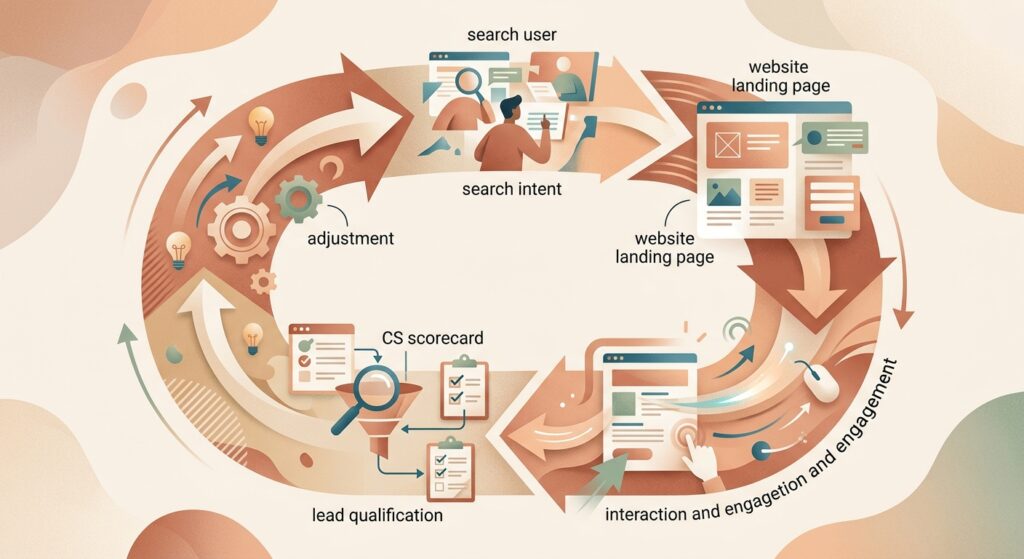
SEO conversion rate optimisation is often treated as a hand-off: SEO earns the visit, then CRO attempts to improve the page. That division is convenient, but it leaves money and learning on the table.
A stronger model is a feedback loop. Search-query data tells you what visitors expected. Landing-page behaviour shows where that expectation broke down or progressed. Conversion and CRM data reveal whether the resulting leads were useful to the business. The learning then changes the page, the content brief, the internal-linking path and sometimes the keyword target itself.
This matters because an increase in organic form fills is not automatically progress. A page can convert more visitors while attracting poorer-fit enquiries. Equally, a page with a modest headline conversion rate can be a priority if its leads consistently become opportunities. The operating goal is not maximum conversion volume. It is more qualified pipeline from relevant organic demand.
Here is the practical system I recommend for a business or marketing team that wants SEO and CRO to inform each other rather than compete for attention.
Start with a shared definition of a qualified organic lead
Before looking at scroll maps or rewriting a headline, agree on what counts as a meaningful result. A completed contact form may be a useful micro-conversion, but it is not a business outcome by itself.
For many B2B teams, the hierarchy looks like this:
- Primary outcome: qualified lead, booked sales conversation, opportunity, or revenue where tracking permits.
- Secondary outcome: form submission, demo request, consultation booking or phone call.
- Diagnostic actions: CTA clicks, pricing-page visits, form starts, engagement with proof, and return visits.
Document the definitions, the CRM field that records them, and the owner responsible for updating them. If sales marks lead quality inconsistently, fix that process before making confident page-level decisions. For a deeper measurement design, see SEO lead quality tracking: how to connect search to pipeline and revenue.
Also establish a practical attribution rule. Organic search is rarely the only touchpoint in a considered purchase, so avoid pretending it is. A useful reporting view includes first-touch organic source, landing page, assisting sessions and CRM outcome. The specific attribution model is a management choice, not a universal truth. What matters is applying it consistently enough to compare pages over time.
Build one page-level dataset, not four disconnected reports
The feedback loop starts with a joined view of page performance. It does not need sophisticated infrastructure on day one. A spreadsheet, dashboard or warehouse table can work if URL normalisation and dates are handled carefully.
Use the landing page as the common key and include the fields below.
| Data source | Useful fields | Question it answers |
|---|---|---|
| Search data | Clicks, impressions, queries, country, device, average position | What problem or intent brought visitors here? |
| Analytics | Organic sessions, engaged sessions, CTA clicks, form starts, conversions | Where does momentum build or disappear? |
| Behaviour research | Session recordings, heatmaps, polls, form errors | What friction or uncertainty is visible? |
| CRM and sales | Lead status, segment, deal stage, disqualification reason, value | Were these the right enquiries? |
Google’s own Search Central documentation is the primary reference for how Google describes crawlability, indexing and search appearance. Use it when a proposed SEO change depends on Google-specific behaviour. For Bing-specific visibility and webmaster tooling, consult Bing Webmaster Tools rather than assuming Google data represents every search audience.
A 90-day analysis window is a testable heuristic, not a platform rule. It often supplies enough volume to spot recurring patterns while limiting the effect of old page versions. Shorten it for high-traffic pages or major changes; lengthen it for low-volume, longer sales-cycle pages. Always annotate redesigns, tracking changes, campaign launches and seasonality so a trend is not mistaken for a page improvement.
Translate search queries into visitor expectations
Ranking keywords are not enough. Group the actual queries by the job a visitor appears to be trying to complete: compare options, understand a problem, check pricing, evaluate implementation, find a local provider, or request help now.
Then compare that query cluster with the landing page’s opening section. The first screen should make a credible, specific response to the dominant intent. If visitors search for implementation cost and land on a broad service page with no commercial framing, a prettier button will not solve the core mismatch.
Look for four common gaps:
- Information gap: the page does not answer the question that earned the click.
- Audience gap: the copy speaks to a different company size, role or use case.
- Evidence gap: the claim is relevant but unsupported by process detail, examples, constraints or proof.
- Action gap: the visitor can understand the offer but cannot take an appropriately low-friction next step.
Search intent mapping should be revisited whenever queries shift, rather than being a one-time keyword exercise. This is especially important where several pages attract overlapping terms. A weak conversion rate can be caused by the wrong page ranking, not by weak on-page persuasion. Run a SEO cannibalisation audit before testing cosmetic changes across competing URLs.
Diagnose friction with behaviour data and sales language
Behaviour tools are valuable for forming hypotheses, not for declaring statistical proof. Ten recordings showing visitors repeatedly abandoning a long form may be a useful lead; it is not sufficient evidence that every visitor feels the same way.
Pair observed behaviour with sales feedback. Ask sales or customer-success teams to tag objections and disqualification reasons in a small, consistent vocabulary: too small, wrong geography, insufficient budget, unclear need, competitor research, unsuitable timeline, or poor service fit. Review a sample of calls and form submissions as well. CRM labels alone can conceal a messaging problem.
The most useful insights often sound unglamorous: prospects expected a price range, misunderstood the delivery scope, wanted an example relevant to their sector, or assumed a feature was included. These observations give the page team a concrete job to do.
Do not automatically add every objection to every page. A detailed pricing section on an early-stage educational guide may repel visitors who are not ready for it. Match the response to the page’s intent and the next reasonable action.
Prioritise pages using qualified-lead opportunity, not conversion rate alone
A page with a 1% conversion rate may deserve more attention than one at 4% if it receives much more qualified traffic or addresses a strategically valuable service. Conversely, low traffic and low-quality leads are rarely the first CRO project.
Score each candidate page using a simple, transparent model:
Priority = relevant organic traffic × qualified-lead gap × business value × confidence ÷ effort.
Use relative scores such as 1 to 5 rather than false precision. The qualified-lead gap is your assessment of the difference between current performance and a plausible improvement opportunity, based on intent fit, visible friction and sales evidence. Confidence should fall when sample sizes are thin or tracking is incomplete.
This is a testable prioritisation heuristic, not a forecasting formula. Its value is forcing a discussion of trade-offs. A team can reasonably choose a lower-scoring page because it supports a product launch, but the exception should be explicit.
Maintain a separate queue for content opportunities. Repeated unanswered search questions may require a new supporting page or a clearer FAQ, not more copy on the conversion page. The framework in turning customer questions into an SEO content pipeline can help turn those gaps into useful assets.
Design tests that protect search intent
Every CRO change on an SEO landing page has two jobs: improve the visitor’s decision and preserve or strengthen the page’s relevance to the searcher. That is why indiscriminately removing explanatory copy, changing headings to vague slogans, or hiding useful detail behind forms can be risky.
Write each experiment as a falsifiable statement: “For visitors arriving on cost-related queries, placing a clear pricing approach and qualification criteria above the primary CTA will increase qualified enquiries because it reduces uncertainty before contact.”
Then define:
- the affected URL and query segment;
- the primary outcome, usually qualified-lead rate or qualified-lead count;
- guardrails such as organic clicks, rankings for core terms, form completion quality and spam rate;
- the change, implementation date and planned review point; and
- what result would cause you to keep, revise or reverse the change.
Where traffic supports it, use a controlled experiment. Where it does not, use a clearly annotated before-and-after comparison and treat the result with more caution. Do not claim causality when several changes occurred at once. For a disciplined approach to this problem, read SEO experiments with clean measurement.
Run a monthly learning loop with clear owners
The workflow becomes sustainable when it has a rhythm. In a monthly review, the SEO owner brings query and landing-page changes; the CRO or web owner brings behaviour evidence and completed tests; sales brings lead-quality patterns; and a commercial lead resolves priorities.
A quarterly audit cadence is also a testable operating heuristic, not an industry requirement. Quarterly reviews are often frequent enough to identify recurring content, technical and lead-quality issues without creating constant reporting overhead. Faster-moving sites may need monthly portfolio reviews; low-volume sites may benefit from a longer view.
Keep a simple decision log: what changed, why, what audience it served, expected outcome, result, and next action. This prevents the same debate returning six months later and gives AI-assisted analysis a reliable source of truth. Automation can cluster queries, flag URL anomalies and summarise CRM notes, but a human should validate intent and decide which trade-off is acceptable.
FAQ and conclusion
What is SEO conversion rate optimisation?
It is the practice of improving how effectively organic landing pages turn relevant search visitors into meaningful actions, while maintaining alignment with the query and intent that brought them there. The best measure is usually qualified leads or downstream pipeline, not raw form fills alone.
Which pages should be tested first?
Start with pages that combine relevant organic traffic, a credible intent or friction problem, and commercial value. Check lead quality before prioritising a low conversion rate. A high-traffic page attracting poor-fit leads may need clearer qualification, while a valuable page with little traffic may need SEO work first.
How long should we wait before judging a change?
There is no universal waiting period. Use enough post-change data to account for normal variation, traffic volume and sales-cycle lag. Treat fixed windows as testable heuristics, annotate other changes, and avoid strong causal claims from a small sample.
Conclusion
An SEO-to-CRO feedback loop replaces isolated dashboards with a practical decision system. Connect query intent to page behaviour, connect behaviour to qualified lead outcomes, and connect sales objections back to content and page design. That loop will not make every page a winner. It will, however, help your team spend effort where better search traffic and better conversion experience can reinforce each other.