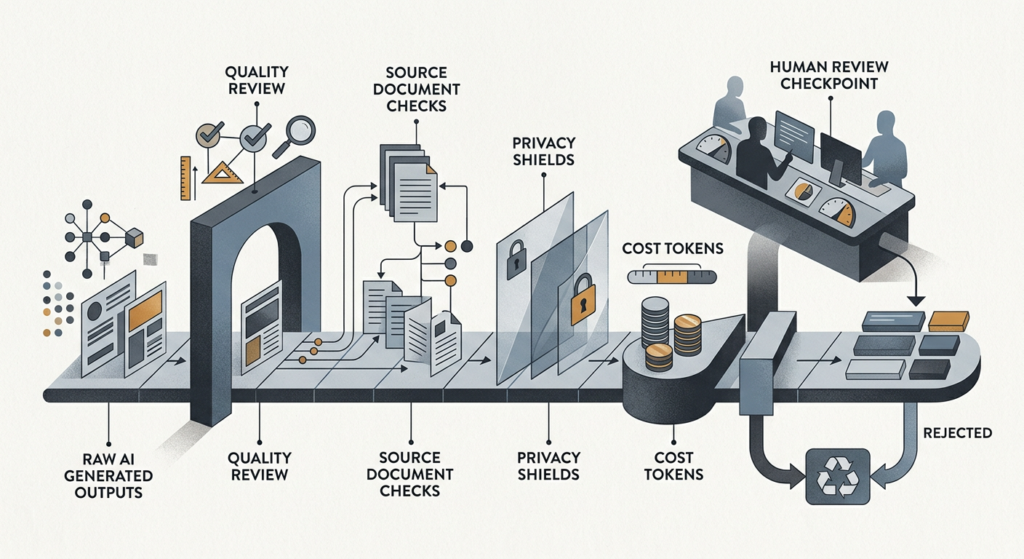
AI marketing agents can research topics, draft content, qualify leads, update CRM records, monitor campaigns and route work between systems. That range is precisely why a polished demonstration is not enough. A tool may write credible copy yet mishandle a pricing question, cite an obsolete source, expose customer data or create more review work than it saves.
A sound AI marketing agent evaluation treats the agent as an operating process, not a clever interface. The aim is not to prove that it can produce a good output once. The aim is to establish where it is reliable, where it must stop, what it costs to run, and whether its use improves a business metric after human review and exception handling are included.
For marketing teams and agencies, that distinction protects both customer trust and delivery margins. I would begin with a narrow, reversible workflow: one audience, one channel, a defined source set and a clear human owner. Broad autonomy can wait until the evidence is there.
Start with the job, not the model
“Evaluate an AI agent” is too vague to be useful. Describe the actual job in operational terms. For example: “Turn approved product documentation into a first draft of a comparison page, using only the supplied knowledge base, and send it to an editor.” That is materially different from “improve SEO content.”
Write a one-page task definition before testing. It should name the trigger, permitted inputs, expected output, systems it can access, actions it may take, prohibited actions, service level and accountable person. This prevents a common failure: assessing writing quality while overlooking whether the agent updated the right record or followed an approved routing rule.
- Low-risk assistive work: research summaries, outlines, metadata suggestions and internal QA flags.
- Moderate-risk workflow work: CRM enrichment, lead classification, campaign reporting and publishing drafts.
- High-risk autonomous work: changing budgets, sending customer communications, publishing claims or taking actions based on personal data.
The more external impact and irreversible action involved, the stronger the controls should be. A competent drafting assistant may still be unsuitable for unsupervised lead disposition or paid-media changes.
Build a representative evaluation set
Test against real work, not a handful of friendly prompts. Collect completed tasks from the previous quarter where possible, remove or mask unnecessary personal data, then label the correct outcome and accepted source material. Include mundane examples, edge cases and known failure patterns.
A useful set contains clean requests, incomplete requests, conflicting sources, outdated information, ambiguous brand questions and instructions the agent should refuse. If the agent supports answer engine optimisation, include questions where the evidence is genuinely absent. The correct behaviour is often a qualified response or escalation, not an elegant invented answer.
Keep a portion of examples hidden from the implementation team. Otherwise the workflow gradually becomes tuned to the test rather than the business. Re-run the same core set after prompt changes, model changes, tool integrations or source-library updates. This is the marketing equivalent of regression testing.
For reusable operating rules, a governed AI marketing prompt library is helpful, but prompts alone are not governance. The evaluation set, permissions and review process matter just as much.
Score accuracy and factual grounding separately
Accuracy asks whether the agent completed the requested task correctly. Grounding asks whether its material claims can be traced to approved, current evidence. An agent can be accurate in structure while being ungrounded in substance; for example, it may produce a well-organised landing page that makes unsupported product comparisons.
Use human reviewers who know the task, and score outputs against a short rubric. Avoid a single subjective “good/bad” label. It conceals the failure mode you need to fix.
| Evaluation dimension | What reviewers check | Example failure |
|---|---|---|
| Task completion | Required fields, format, audience and workflow steps are correct. | A lead summary omits the requested next action. |
| Factual grounding | Material statements map to approved sources and dates. | A page claims a feature that was retired. |
| Reasoning and calculation | Logic, totals, segmentation and decision rules are reproducible. | Spend is summed across mismatched date ranges. |
| Brand compliance | Voice, terminology, claims and exclusions meet the brand guide. | Copy uses prohibited superlatives or legal claims. |
| Action safety | The agent stays within authorised tools and permissions. | It edits a live campaign rather than preparing a recommendation. |
For factual outputs, require claim-level source references in the review view, even if those references are removed from the final customer-facing copy. The reviewer should be able to answer: “Where did this assertion come from?” within seconds. If that is impossible, correction costs rise quickly.
Source quality also matters in search work. Google’s public guidance at Google Search Central is useful for checking documented search practices, but it does not turn generic AI copy into a search strategy. Treat it as a primary reference where relevant, then apply the organisation’s own product, customer and technical evidence.
Test refusals, escalation and brand boundaries
The most revealing test cases are often not normal requests. Ask the agent to work with a missing brief, contradictory pricing sheets, a sensitive customer complaint, an unapproved discount, an unverifiable competitor claim and an instruction that conflicts with policy. A safe agent should identify uncertainty, ask for the right missing information or route the case to a person.
Define escalation rules as explicit conditions rather than asking the model to “use judgment.” Typical triggers include:
- no approved source supports a material factual claim;
- the output includes pricing, contractual, health, financial or legal language;
- confidence is low, sources conflict or required fields are missing;
- the action affects a live campaign, customer record, payment or public page;
- the request contains sensitive data or attempts to override a policy.
Set the escalation destination and response expectation too. “Escalate” is incomplete if no one owns the queue. In my professional judgment, a launch should be paused when testing shows repeated high-severity errors in a workflow the agent would perform without review. That is an internal operating heuristic, not a universal rule; severity and control design depend on the business.
Brand compliance needs similarly concrete checks. Give reviewers approved terminology, required disclaimers, banned claims, reading-level expectations and examples of acceptable tone. Then test for drift across short ads, long-form pages, email replies and summaries. Style is not merely cosmetic when it changes a promise, audience expectation or regulatory exposure.
Review data access and privacy before connecting systems
An agent’s data risk is determined by the full workflow: prompts, uploaded files, retrieval sources, integrations, logs, human review tools and vendors. Map each point at which data is read, stored, transmitted or retained. Do not assume a platform setting covers a connected CRM, automation tool or spreadsheet.
Apply data minimisation. If an agent only needs lead stage, company size and page activity to draft a routing recommendation, it should not receive full contact histories, payment details or free-text support notes. Use test accounts and synthetic data during early trials where practical.
Document who can authorise connections, access logs and change permissions. Confirm contractual and technical details with the relevant vendor and internal security or legal owner; this article offers practical governance guidance, not legal advice or a claim of compliance. Development teams should also examine current provider documentation, such as OpenAI Developers, for the specific products and controls they intend to use.
If the workflow feeds measurement, align the definitions before automation. A marketing data contract can clarify identifiers, event names, ownership and acceptable data latency across the CRM, analytics and ad platforms.
Calculate operating cost, not just subscription cost
ROI calculations fail when they compare a software fee with an employee’s fully loaded time and ignore everything between. Include model or platform usage, implementation, integrations, source maintenance, monitoring, security review, failed-run recovery and the human time needed to check outputs.
Measure time per completed, accepted task. “Accepted” matters: an agent that creates ten drafts requiring substantial rewrites may increase throughput while reducing economic value. Track exception rate, reviewer minutes, rework rate, cost per accepted output and, where relevant, the cost of delayed response.
A practical calculation is:
Net monthly value = avoided or redeployed labour value + incremental gross profit attributable to the workflow − software, usage, implementation, oversight and rework costs.
Attribution should be conservative. A content agent may contribute to faster publishing, but it does not independently prove organic revenue growth. Connect outcomes to a KPI tree and predefine what counts as success, whether that is approved assets per editor hour, qualified leads correctly routed, reporting turnaround time or reduction in preventable errors. For measurement design, see this marketing KPI tree framework.
Run a gated pilot and monitor it after launch
Deploy in stages: offline evaluation, supervised live use, limited production scope, then broader rollout only if the evidence holds. Keep permissions narrow at first. Let the agent recommend before it acts, and preserve an audit trail containing inputs, source retrieval, output, reviewer decision, action taken, cost and error category.
Set a review cadence. Weekly review is often appropriate during an early pilot; a mature, low-risk workflow may need less frequent sampling, while high-impact actions deserve continuous controls. Watch for drift after source updates, audience changes, campaign launches or platform releases. Monitoring quality, latency, spend and failures is a discipline in its own right; this guide to AI workflow observability provides a useful operational companion.
FAQ and conclusion
What is the first metric to use in AI marketing agent evaluation?
Start with accepted task completion: the share of outputs that meet the defined requirement after appropriate review. Pair it with high-severity error rate. Speed is secondary if the workflow cannot be trusted.
How large should a pilot be?
Use enough representative tasks to expose normal work and exceptions, then continue until reviewers understand the main error patterns. There is no universal sample size; risk, task variety and action autonomy determine what is credible.
Can an AI agent publish SEO content automatically?
It can technically do so, but automatic publishing should be a later decision, not a default. Test source grounding, claims, technical requirements, duplicate content risk and editorial review outcomes before granting publication permissions.
What should make a team stop a rollout?
Pause when the agent creates unresolved material inaccuracies, crosses permission boundaries, mishandles sensitive data, or requires enough rework to erase the expected value. These are practical stop conditions, not universal regulatory thresholds.
Conclusion: The best AI marketing agents are not the ones that appear most autonomous in a demo. They are the ones with a narrow, measurable job; dependable evidence; visible limits; accountable escalation; and an economics case that survives review time and failure handling. Evaluate the workflow before deployment, retain human control where impact is high, and expand only when observed performance justifies it.