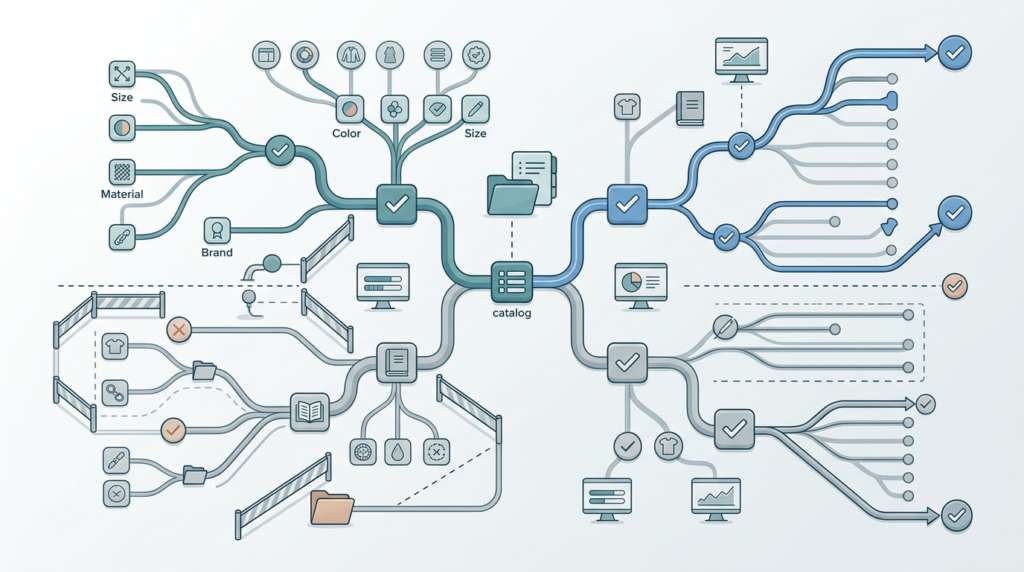
Faceted navigation is useful because it helps people narrow a large catalogue quickly. It is difficult for SEO because every filter, sort order and combination can create another URL. On a modest ecommerce site, that can mean thousands of technically valid pages with little independent search value. On a large marketplace, it can mean millions.
The answer is not to block every filtered URL or to index them all. Both approaches are crude. Effective faceted navigation SEO is a governance problem: define which combinations deserve search visibility, which may be crawled but should stay out of the index, and which should not be discoverable to crawlers at all.
The system below turns that decision into repeatable rules. It gives SEO, product, engineering and merchandising teams a shared way to make changes without reopening the same debate for every new filter.
Start with the three decisions people often merge
Every URL pattern needs three separate decisions. Treating them as one is the source of many avoidable problems.
- Crawlable: Can a search engine request the URL and access its content?
- Indexable: Is the page eligible to appear as a search result?
- Internally linked: Do ordinary site links expose the URL as a meaningful destination?
A page can be crawlable without being indexable. It can be indexable without being linked prominently, although that is rarely a strong long-term strategy. And a page blocked from crawling cannot reliably communicate page-level directives to a crawler, because the crawler cannot retrieve them.
My practical preference is to manage demand before relying on exclusion: do not generate or link to low-value combinations in the first place. Then use page directives, canonicalisation and crawl controls as safeguards for URLs that still exist through legacy links, user behaviour or external discovery.
Build a filter inventory before writing rules
Do not begin with a robots.txt file or a blanket noindex rule. First document the actual parameter and path ecosystem. Export URLs from crawl data, XML sitemaps, analytics landing pages, server logs where available, Search Console reports and the platform’s route definitions. Group URLs by pattern rather than reviewing samples at random.
Your inventory should record each facet’s name, URL syntax, value count, default state, business purpose, inventory dependency, whether it changes the primary product set, and whether it creates a distinct search intent. Include utility modifiers such as sort, pagination, view mode, currency, tracking parameters and session identifiers. They are not all “filters,” but they frequently multiply the same URL space.
| Facet type | Typical example | Default governance posture |
|---|---|---|
| Core category | Running shoes | Indexable, linked and included in sitemap |
| High-demand attribute | Women’s waterproof running shoes | Candidate for approved indexable landing page |
| Low-value refinement | Size 8 + blue + brand + sale | Useful to shoppers; normally not indexable or broadly linked |
| Sort and display state | Price low to high, grid view | Not indexable; avoid crawl paths where feasible |
| Tracking or session state | Campaign parameter or session ID | Normalise, strip or prevent generation where possible |
The table is a starting point, not a substitute for evidence. A colour filter may be a weak refinement for one retailer and a major query class for another. Governance should preserve that distinction.
Create a qualification model for indexable combinations
Indexable facet pages should clear a higher bar than “the platform can generate them.” Use a scorecard that is easy to audit and difficult to game. I would require evidence across five areas.
- Search intent: Is there a recognisable query theme that maps cleanly to this combination?
- Commercial and user value: Does the page help a visitor compare or buy, rather than merely expose an arbitrary database state?
- Stable supply: Is there enough live inventory, listings or content to make the page useful over time?
- Distinctiveness: Does the result set and page proposition materially differ from the parent category and other approved pages?
- Maintainability: Can the business create a stable title, heading, copy, metadata, internal links and quality controls for it?
Set thresholds in writing. For example, an approved combination may require a documented query theme, a minimum active-item threshold appropriate to the category, and no conflict with an existing category or editorial landing page. The numerical threshold is a business choice, not a universal SEO rule. Seasonal departments, luxury catalogues and B2B ranges need different tolerances.
Approved pages deserve purposeful templates. Give them a clear H1, accurate title, concise explanatory copy where useful, product-listing content, breadcrumb logic and relevant links from category hubs. Do not manufacture hundreds of near-identical introductions. If the combination cannot support a useful page without filler, it probably should not be an indexable destination.
Define URL states in a policy matrix
A policy matrix makes the decision operational. Each route family should map to a named state, with a single owner and a technical implementation. Avoid vague labels such as “SEO-friendly.”
| State | Use case | Typical treatment |
|---|---|---|
| Approved landing page | Validated category or facet combination | Self-referential canonical where appropriate, indexable, sitemap eligible, linked from curated hubs |
| Functional refinement | Helpful shopping filter without standalone demand | Keep usable for visitors; noindex if it can be crawled; do not add to navigation hubs or sitemaps |
| Duplicate variant | Equivalent parameter order, sort state or display state | Normalise URL generation and canonicalise to the preferred equivalent where a true equivalent exists |
| Forbidden or expired pattern | Malformed, impossible or retired routes | Stop internal generation; return an appropriate response or redirect only when a clear replacement exists |
Canonical tags are signals, not a licence to create unlimited duplicate URLs. They work best when the chosen canonical is genuinely equivalent or the clearest representative of a closely related set. A filtered page with a meaningfully different set of products should not automatically canonicalise to a broad parent merely because the team does not want it indexed. In that case, control discovery and use an indexability directive suited to the page’s purpose.
URL normalisation is often the biggest technical win. Fix parameter ordering, casing, trailing slash behaviour, duplicate values and default filters at the application layer. One product set should not have ten URLs because filters were clicked in a different sequence.
Control internal linking without degrading usability
Navigation is an editorial system as well as a user interface. Every crawlable hyperlink tells search engines that a destination may matter. That does not mean hiding ordinary filters from customers. It means controlling which states are exposed as crawlable links and which are handled through interaction patterns that are tested for accessibility and usability.
Reserve persistent HTML links for approved categories, high-value subcategories and a limited set of validated facet destinations. Let shoppers apply deeper refinements, but avoid building sitewide link paths to every multi-select state. Pagination, sort controls and “show more” behaviours need the same review; they can create vast crawl paths even when the facet policy is sound.
This trade-off should be assessed with accessibility in mind. A search-friendly implementation that prevents keyboard users from operating filters is a poor release. The principles in an SEO accessibility audit framework are useful here: test the interface people use, not only the rendered source code.
Implementation caveats: verify behaviour before rollout
Platform behaviour varies, so governance rules must be tested on the live rendering path. Google’s public documentation should be the reference point for Google-specific decisions about crawling, indexing, canonicalisation, sitemaps and robots controls; review the current guidance at Google Search Central before release. For Bing-specific validation, consult Bing Webmaster Tools and its current guidance rather than assuming parity.
In particular, test whether directives appear in the HTTP response or rendered HTML available to crawlers; whether JavaScript-generated filter links expose unwanted URL paths; whether canonical tags resolve to the intended absolute URL; and whether pagination retains access to eligible products. Do not rely on a staging crawl alone. Staging environments often differ in middleware, caching, edge rules, authentication and inventory feeds.
Also separate analytics parameters from SEO route logic. Parameter removal, consent configuration and measurement collection are implementation-specific matters that depend on jurisdiction, the measurement setup and user choices. They should be reviewed with the relevant legal, privacy and analytics owners, not treated as an SEO-only decision. For a stronger measurement handoff, use a documented marketing data contract between CRM, analytics and ad platforms.
Turn the policy into templates, controls and approvals
A spreadsheet is not governance unless it changes what the platform can publish. Convert the matrix into reusable controls: route allowlists, facet allowlists, parameter normalisation rules, inventory thresholds, title and metadata templates, sitemap inclusion criteria and internal-link modules.
Every newly proposed indexable facet should have a short request record: proposed URL pattern, target query theme, sample SERP review, inventory profile, duplicate-risk assessment, intended template, internal-link source, owner and rollback plan. SEO should not be the only approver. Merchandising validates product logic, engineering validates route behaviour, and content or brand teams validate the page proposition.
Make changes reversible. Use a release checklist, test representative URLs and retain before-and-after exports. A disciplined SEO website QA process is particularly valuable when filter components are shared across multiple departments or country sites.
Monitor the system as a product, not a one-time cleanup
Track the number of discovered facet URLs by pattern, crawled URLs by pattern, indexed pages, canonical selections, sitemap coverage, soft errors, server response patterns and organic landing-page performance. Pair search data with internal signals: inventory depth, zero-result rates, filter usage and conversion quality. An indexable page that repeatedly has no viable products is not serving either searchers or the business.
Use alerts for sudden growth in parameterised URLs, new parameter names, sharp rises in noindex pages, unexpected canonical changes, sitemap inflation and inventory collapse across approved pages. Crawl samples should include edge cases: empty combinations, discontinued values, reversed parameter order, multi-select facets, paginated results and locale variants.
When performance changes, do not assume the facet system is the cause. Check releases, feed changes, robots rules, rendering, duplicate expansion and demand shifts. The investigation sequence in this organic traffic anomaly framework helps prevent convenient but weak conclusions.
FAQ and conclusion
Should every filtered URL be blocked in robots.txt?
No. Blocking is not a universal duplicate-content solution, and it can prevent crawlers from seeing page-level signals. First reduce needless URL generation and internal links. Then choose controls according to the page state and test them against current search-engine documentation.
When should a facet page become a landing page?
Approve it when it serves a clear query and user task, has stable supply, is meaningfully distinct from nearby pages, and can be maintained with an honest template. Search volume alone is not enough.
How often should the policy be reviewed?
Review quarterly, and after platform releases, taxonomy changes, feed migrations or major inventory shifts. Monitor high-risk patterns continuously.
Conclusion: Good faceted navigation SEO does not attempt to make every possible combination rank. It creates a deliberate catalogue of search destinations and keeps the rest useful for shoppers without letting it consume disproportionate crawl, index and maintenance capacity. Write the rules, embed them in templates, require approvals for exceptions and monitor the output. That is how a fragile technical issue becomes a manageable operating system.