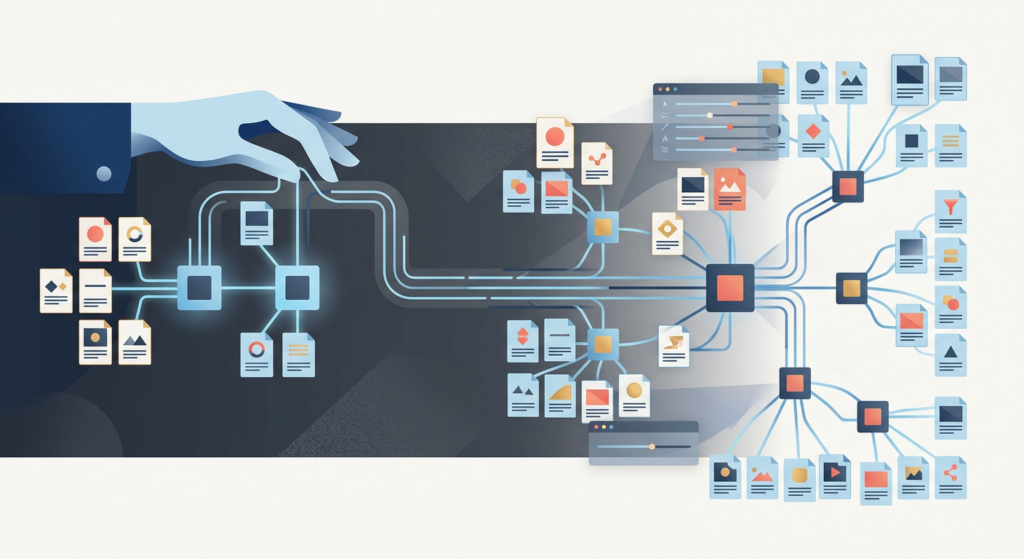
Internal linking usually starts as an editorial task: publish a page, find a few relevant articles and add links between them. That approach works on a small website. It becomes unreliable once the site has hundreds of URLs, several contributors, overlapping topics and a backlog of ageing content.
The problem is not a lack of links. It is the absence of a system for deciding which pages should link, where those links should appear, what anchors should say and who is responsible for maintaining them.
Effective internal linking systems that scale combine information architecture, editorial judgment, automation and measurement. They help search engines discover and interpret pages, but they also help visitors move from an initial question to a useful next step. Those two objectives often overlap, though not perfectly.
My practical view is that internal linking should be treated as part of the publishing operation, not as a periodic SEO clean-up. The system needs rules, exceptions and quality controls that remain workable as the website grows.
What scaling internal linking actually means
Scaling does not mean adding the maximum possible number of links. It means maintaining useful relationships between pages without requiring an SEO specialist to inspect every sentence manually.
A scalable system should answer five questions:
- What role does each page play? Is it a hub, supporting guide, commercial page, comparison, case study or utility page?
- Which relationships justify a link? Topic similarity alone is not enough. The destination should advance the reader’s task.
- Where should the link appear? A contextual link in the body serves a different purpose from a breadcrumb, navigation link or related-content module.
- How should the anchor be written? It needs to describe the destination without becoming repetitive or misleading.
- How will the relationship be maintained? Links need to survive URL changes, content consolidation and shifts in business priorities.
This is why plugins and automated recommendations are only components. They can identify candidates or apply approved rules. They cannot independently determine whether a link makes sense for the visitor, represents the intended hierarchy or sends attention to the right commercial page.
Start with page roles, not keywords
The most reliable foundation is a page inventory with defined roles. Without it, internal linking tends to reinforce whichever pages already attract attention rather than the pages that are strategically important.
A practical inventory can contain the URL, canonical status, indexability, page type, primary topic, search intent, business relevance, content owner and preferred parent or hub. Traffic and link counts are useful additions, but they should not replace classification.
Intent deserves particular attention. Two pages can share vocabulary while serving different jobs. A broad educational guide may logically link to a specialist service page, while two near-duplicate educational articles may need consolidation rather than reciprocal links. The framework in search intent mapping for B2B websites provides a useful way to separate those cases.
I generally classify internal link relationships into four groups:
- Structural links establish hierarchy through navigation, breadcrumbs, category pages and hubs.
- Contextual links connect a specific passage to a useful supporting or next-step page.
- Commercial pathways move an informed visitor towards a service, product, demo, contact or comparison page.
- Maintenance links repair orphan pages, replace redirected destinations and reconnect content after consolidation.
A single link may perform more than one function. The classification still helps because it forces the team to state why the link exists.
Design a hub-and-supporting-page architecture
A topic map provides the planning layer for internal links. Each important subject should have a clear central page, supporting pages that answer narrower questions and sensible routes to relevant commercial destinations.
This is not a requirement to force every website into rigid topic clusters. Some subjects overlap, and visitors do not think in perfectly separated silos. Cross-topic links are appropriate when they clarify a concept or support the next decision.
The central principle is directional clarity:
- Supporting pages should normally link to their principal hub.
- Hubs should link to the supporting resources needed to understand the subject.
- Related supporting pages should link when one genuinely helps complete the other’s task.
- Informational pages should link to commercial pages only where the transition is relevant and appropriately framed.
- Commercial pages should link back to evidence, methodology or explanatory material when that information reduces uncertainty.
A defensible topical authority map can become the source of truth for these relationships. It is more useful than a loose spreadsheet of keywords because it records the subjects the business is qualified to cover and the purpose of each page.
Define editorial rules that writers can apply
Vague instructions such as “add three internal links” produce predictable problems. Writers link to the easiest pages to find, repeat the same destinations and satisfy a quota without improving navigation.
Use decision rules instead. A workable editorial standard might require a writer or editor to:
- Link to the primary hub when the article belongs to an established topic group.
- Add supporting links where a reader would otherwise need an unexplained detour.
- Include a next-step link when there is a natural progression towards evaluation or action.
- Prefer canonical, indexable and current destinations.
- Avoid linking several anchors in the same section to substantially similar pages.
- Review existing pages that should link back to the new article.
The final rule is frequently missed. Internal linking is bidirectional work. Adding links from a new article does not prevent it from becoming an orphan if older authoritative pages never point towards it.
Write anchors for people and machines
Anchor text should set a reasonable expectation of what happens after the click. Descriptive anchors are usually more helpful than “read more” or “click here”, especially when links are encountered outside their surrounding paragraph.
Exact-match anchors are not automatically wrong, but repeating one phrase mechanically across a large site creates awkward copy and can obscure differences between destination pages. Use natural variations that remain specific: the process, question, page type or decision being discussed.
Avoid inserting links solely because two pages contain the same phrase. Shared language is a candidate-generation signal, not an editorial decision. The surrounding passage and destination intent determine whether the link belongs.
Set practical limits rather than universal link counts
There is no useful site-wide number of internal links that applies to every page. A long resource may justify many references. A focused service page may need only a small set of supporting links.
Instead of enforcing a fixed count, review concentration and relevance. Warning signs include repetitive blocks, multiple links competing for the same click, unrelated commercial links and boilerplate modules that appear on nearly every page.
Build internal linking into the publishing workflow
The most scalable intervention is a workflow change. Internal linking should have checkpoints before publication and after a page enters the live site.
Before drafting
The brief should specify the page role, parent topic, likely supporting resources and intended next step. This reduces the need to retrofit links once the article has already settled into an unsuitable structure.
During editing
The editor should validate relevance, destination status and anchor clarity. This is also the moment to remove links inserted merely to satisfy a quota.
At publication
Confirm that links render as crawlable HTML links, resolve to the intended canonical URLs and are not unintentionally blocked. Google Search Central publishes current technical guidance for search discovery and link implementation; it should take precedence over inherited agency checklists when platform documentation changes.
After publication
Identify existing pages that should link to the new URL. Candidate sources can be found through site search, a crawler, embeddings, keyword matching or a content inventory. An editor should approve high-impact insertions.
Then schedule recurring checks for broken destinations, redirect chains, orphan pages, excessive click depth and pages whose internal link profile changed after a migration or consolidation.
This workflow fits naturally into a broader SEO operating system for a small team, where ownership and review frequency are defined rather than assumed.
Use automation to generate candidates, not unchecked decisions
Automation is valuable when the website is too large for editors to recall every relevant page. The safest pattern separates candidate generation from publication.
A practical pipeline can work as follows:
- Extract indexable pages and their clean body text.
- Attach metadata such as topic, intent, page type, status and priority.
- Generate potential source-destination pairs using taxonomy, search terms, semantic similarity or explicit business rules.
- Exclude self-links, non-canonical URLs, conflicting intents and already overused destinations.
- Rank opportunities by contextual relevance and strategic value.
- Present the sentence, suggested destination and reason for review.
- Require approval for contextual changes, while allowing low-risk technical repairs to run automatically.
Automation should be more conservative on revenue-critical pages, regulated topics and high-traffic templates. Fully automatic insertion may be reasonable for controlled components such as breadcrumbs or a tightly governed glossary. It is riskier inside editorial prose, where a technically relevant phrase can still produce an unhelpful or misleading link.
The same caution applies to programmatic websites. Generating thousands of pages and then cross-linking them through a formula can magnify weak architecture. Before automating that model, use a decision framework such as when programmatic SEO is a bad idea.
Create guardrails for templates and modules
Template links scale quickly, which makes both their benefits and mistakes site-wide. Treat them as product logic rather than decorative widgets.
A related-content module should have declared eligibility rules. For example, it might include pages from the same topic family, exclude noindex and redirected URLs, avoid the current page, favour recently reviewed content and limit repeated exposure of one destination.
Navigation should reflect stable user needs, not every keyword the business hopes to rank for. Footer links are especially easy to overload. They can support access to important utility or category pages, but they are a poor substitute for contextual relationships and a coherent hierarchy.
Breadcrumbs are useful for communicating location when the site genuinely has a hierarchy. They should not invent a misleading parent-child structure simply to insert more links.
Measure whether the system is working
Internal link reporting should separate implementation quality from business outcomes. Implementation measures include orphan status, broken links, click depth, eligible pages linked and destination concentration. Outcome measures include search discovery, organic visits, assisted journeys and conversions where tracking is configured.
The following measurement boundary is intentionally explicit.
| Platform or data source | Mentions | Citations | Referrals | Conversions | What it cannot prove | Collection conditions |
|---|---|---|---|---|---|---|
| Google Search Console / Google Search | No general AI-answer mention reporting | No complete citation-level reporting | Reports eligible Google Search clicks and impressions, subject to its reporting scope | Not directly | That an internal link caused a ranking, click or AI answer | Verified property, sufficient processing time and awareness of aggregation, privacy and reporting limits |
| Bing Webmaster Tools | No comprehensive answer-engine mention measure | No complete cross-platform citation measure | Can report Bing search performance within available reports | Not directly | That one link change caused visibility or traffic | Verified site, valid data collection and consistent date and URL comparisons |
| Web analytics | No | No | Can record sessions when a referrer or campaign parameter is preserved | Yes, if events and attribution settings are configured | All visits from answer engines, or the causal effect of a specific internal link | Consent-aware implementation, working events, stable channel rules and retained referral or campaign data |
| Server logs | No | No | Sometimes, when request headers contain usable referral information | Not without joining other first-party records | That a crawler used page content in an answer or that a request represents a human visit | Log retention, reliable bot classification, privacy controls and consistent URL normalisation |
| Manual answer audit using documented platforms such as OpenAI services | Can observe visible mentions in the tested outputs | Can record visible citations or links in the tested outputs | No aggregate referral measure | No | Population-wide visibility or page influence; matching language alone does not demonstrate that a page influenced an answer | Recorded prompts, platform, model or mode, location where relevant, date, login state and repeatable sampling method |
For operational reporting, I would monitor a compact set of indicators:
- Indexable pages with no internal links pointing to them.
- Priority pages beyond the team’s acceptable click depth.
- Broken internal links and links passing through avoidable redirects.
- Pages receiving a disproportionate share of contextual links.
- Newly published pages that lack links from established relevant pages.
- Clicks on important contextual or commercial pathways, where event tracking is justified.
Compare page groups and time periods rather than expecting a clean causal result from one link edit. Internal links operate alongside content changes, external links, crawling, competition and search-system updates.
Common failure modes
Linking everything to the highest-traffic page
This reinforces an existing winner but may weaken the site’s decision pathways. Destination selection should consider relevance and strategic role, not traffic alone.
Creating reciprocal links by default
If page A helps explain page B, the reverse link is not automatically useful. Direction should follow the reader’s task.
Leaving redirected URLs in place
Redirects are useful safeguards, but internal links should generally be updated to the final canonical destination when practical. This reduces unnecessary hops and simplifies maintenance.
Automating without an exclusion layer
A recommendation engine needs exclusions for inactive offers, outdated content, noindex URLs, canonical conflicts, sensitive page types and phrases where insertion would alter meaning.
Reporting only the number of links added
Link volume is an output, not evidence of improvement. Report whether priority relationships were implemented and whether navigation, discovery or tracked journeys changed.
A practical 90-day implementation plan
Days 1–30: inventory indexable pages, assign roles, identify orphan pages and define high-priority hubs and commercial destinations. Document anchor, destination and exclusion rules.
Days 31–60: repair broken and redirected links, connect priority orphans, update publishing briefs and add retrospective-link review to the editorial process. Pilot opportunity generation on one topic area.
Days 61–90: automate recurring audits, introduce governed template logic and build a small dashboard for implementation and outcome indicators. Review false positives from the pilot before expanding it.
The sequence matters. Automation built before page roles and rules usually scales inconsistency faster than it saves time.
Frequently asked questions
How many internal links should a page have?
There is no universal target. Add links that clarify, support or advance the visitor’s task. Review relevance and concentration rather than enforcing one count across every page type.
Should every article link to a service page?
No. A service link should appear when it represents a credible next step. Forcing one into early-stage or unrelated content can reduce trust and distract from the answer.
Can AI automate internal linking?
It can classify pages, identify candidate passages and suggest destinations. Human review remains valuable for intent, factual nuance, commercial appropriateness and anchor quality.
Are breadcrumbs enough to prevent orphan pages?
Not necessarily. Their value depends on how they are implemented and whether the page is connected to a real hierarchy. Important pages usually also need relevant hub or contextual links.
How often should internal links be audited?
Run technical checks regularly and review strategic relationships after migrations, major content changes or new topic launches. The appropriate frequency depends on publishing volume and site complexity.
Conclusion: scale the decisions, not just the links
Internal linking becomes scalable when the organisation standardises how decisions are made. Define page roles, map meaningful relationships, write usable editorial rules and make retrospective linking part of publication.
Then apply automation selectively. Machines are effective at finding candidates, enforcing exclusions and monitoring technical decay. Editors remain responsible for deciding whether a link helps the reader and supports the intended architecture.
The specific outcome to aim for is not “more internal links”. It is a maintained network in which priority pages are discoverable, supporting content has a clear place, commercial pathways are appropriate and every important link has a defensible reason to exist.