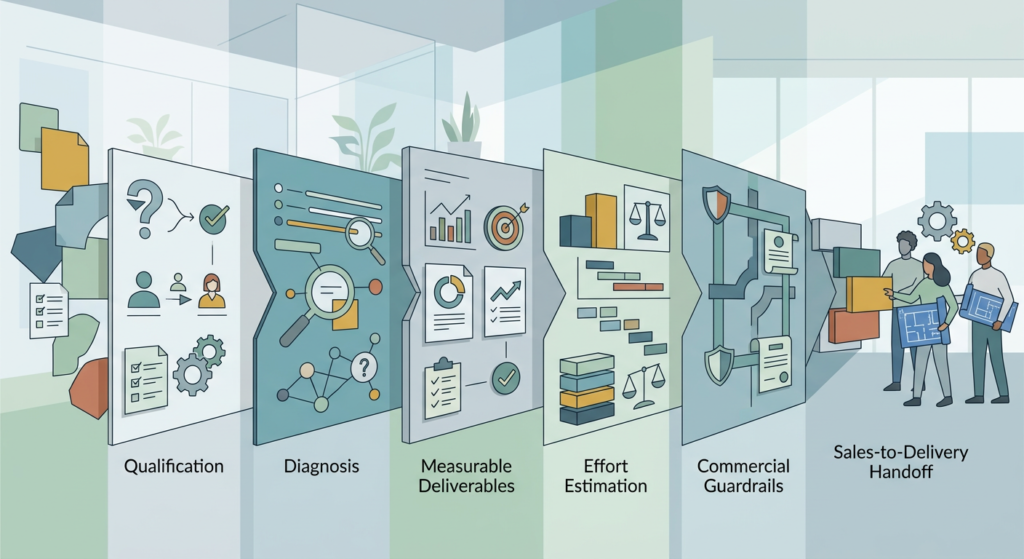
Most agency margin problems begin before a contract is signed. The proposal may look profitable, but it rests on vague goals, untested assumptions, missing client responsibilities and an optimistic estimate of effort. Delivery then inherits a promise rather than a usable plan.
A strong agency discovery and scoping framework solves that problem. It gives sales a repeatable way to decide whether an opportunity is worth pursuing, diagnose what is actually limiting growth and turn that diagnosis into bounded work. Done well, it also improves win rate: capable buyers recognise the difference between a generic pitch and a team that understands the operating constraints behind their brief.
This is not a case for making every sales process longer. It is a case for using the right depth of discovery at the right level of deal risk.
Start with qualification, not a free audit
Discovery should not be a disguised attempt to solve a prospect’s entire marketing programme for free. Before allocating senior strategy time, establish whether the engagement has the conditions required to work.
I use five qualification tests:
- Business fit: Is there a credible commercial objective, such as qualified pipeline, profitable acquisition, retention or market expansion?
- Constraint fit: Does the stated problem fall within the agency’s real capability, including dependencies such as development and creative?
- Access fit: Will the team receive timely access to analytics, CRM data, ad accounts, CMS, subject-matter experts and decision-makers?
- Economic fit: Is the budget sufficient for the likely effort, including strategy, implementation support, reporting and management?
- Operating fit: Can the client approve work, provide inputs and implement recommendations at a pace that makes the target plausible?
Score each test red, amber or green after an initial call. Two reds should normally mean decline, defer or offer a paid diagnostic rather than a full proposal. This is not inflexibility. It stops the agency from accepting work where the commercial model depends on ignoring obvious blockers.
A structured qualification stage also belongs in the wider sales process. A documented pipeline with explicit exit criteria prevents desirable-sounding opportunities from consuming disproportionate senior time. See this related guide to an agency sales pipeline system for the operating discipline behind it.
Find the growth constraint behind the requested service
Clients often arrive with a channel request: “We need SEO,” “We need AI search visibility,” or “We need more leads from paid media.” Those requests matter, but they are not automatically the problem to solve.
Ask questions that move from symptoms to economics:
- What business result must change, by when, and why now?
- Which customer segment, product line, geography or stage of the funnel matters most?
- Where does performance break today: demand, visibility, conversion, sales follow-up, retention, measurement or capacity?
- What has been tried, what happened, and what implementation constraints affected the result?
- What would make this engagement unsuccessful even if channel metrics improved?
Then map the answers to a simple KPI chain: business outcome, leading commercial metric, channel metric and operational input. For example, a B2B firm may need qualified opportunities, not simply organic sessions. Its leading metric could be demo requests from target accounts; the channel metrics may be non-brand impressions and conversion rate; the required inputs could be new solution pages, faster sales follow-up and reliable source data.
This avoids selling content production when the real constraint is an untracked CRM funnel, or promising technical SEO gains when releases are frozen for six months. A marketing KPI tree is a useful way to make these dependencies visible before scope is written.
Run discovery in three layers
1. Commercial and stakeholder discovery
Identify the economic buyer, day-to-day owner, technical owner and final approver. Ask how budget is approved, what procurement requires and whether another agency or internal team owns adjacent work. A scope with no named client owner is a risk, not a detail to tidy up later.
Clarify the baseline too. Request the current budget, major channel performance, sales cycle, conversion definitions and target economics. If the data is weak, state that it is directional and scope measurement repair as an early workstream rather than treating assumptions as facts.
2. Evidence and operating discovery
Review enough evidence to test the stated problem: analytics configuration, CRM stages, channel accounts, site platform, content workflow, release process and recent campaign history. A limited read-only review is usually enough at this stage. Do not promise a full forensic audit unless it is paid and separately defined.
For SEO and answer-engine work, distinguish crawlability, indexability and eligibility for visibility. They overlap, but they are not interchangeable. Google’s guidance is available through Google Search Central, and Bing publishes comparable operational resources at Bing Webmaster Tools. Use those sources to validate implementation details against the client’s stack and current platform behaviour.
3. Solution and feasibility discovery
Present a short problem statement back to the client: the likely constraint, supporting evidence, assumptions and the actions that must be owned by each side. This is the moment to test alignment. If a prospect rejects the diagnosis but still wants the original deliverable, do not quietly absorb the contradiction. Re-scope around their chosen objective, or decline.
Translate findings into a scope that can be delivered
A good scope describes an observable change, not an activity label. “Technical SEO support” invites interpretation. “Audit 250 prioritised template and URL patterns; issue an implementation backlog; validate up to two post-release deployments” is bounded, reviewable and estimable.
| Scope component | What to define |
|---|---|
| Outcome and KPI | The decision-useful measure, baseline source and review cadence. |
| Deliverable | Format, volume, quality standard and acceptance criteria. |
| Work boundary | URLs, markets, templates, campaigns, platforms or business units included. |
| Dependencies | Client inputs, approvals, engineering capacity, legal review and third-party access. |
| Exclusions | Work deliberately not included, plus the route for adding it. |
Use phases where uncertainty is high. A paid discovery or foundation phase can produce the verified backlog, measurement plan and forecast inputs needed to price implementation responsibly. It is often more honest than offering a fixed implementation plan based on incomplete access.
Handle technical scope without universal rules
Technical recommendations need a specific purpose, test method and owner. Avoid blanket instructions such as “block low-value pages” or “add canonicals everywhere.” Controls behave differently depending on the page type, internal linking, content similarity and business use.
- Noindex versus robots.txt: Use a noindex directive when a page may be crawled but should generally stay out of search results, such as an internal campaign thank-you page. Restricting a URL in robots.txt is more appropriate when crawl access itself should be reduced, but it can prevent crawlers from seeing a noindex directive. Confirm the intended outcome in Google and Bing documentation before deployment, then test representative URLs.
- Canonicalisation: Use a canonical signal where substantially duplicate or near-duplicate URLs need a preferred version, such as filtered product URLs that repeat the core category content. Do not treat it as a command or use it to conceal materially different pages. Include self-referencing canonicals where the CMS permits and validate the rendered output.
- JavaScript-generated links: If category navigation is created in JavaScript, verify that important destination URLs are exposed as standard crawlable links after rendering. For example, a “load more” control should not be the only route to products that need discovery; provide paginated or otherwise reachable URLs where appropriate.
- Crawlable versus indexable: A URL can be crawlable without being a good candidate for indexing. For example, a faceted URL may be needed for users but create redundant combinations at scale. Define the user purpose, demand evidence and indexation policy before choosing controls.
These are diagnostic choices, not universal rules. Record the affected URL pattern, rationale, expected signal, validation method and rollback path in the scope. For complex filters, use a formal faceted navigation SEO governance system rather than resolving each issue as an isolated ticket.
Estimate effort from units, uncertainty and seniority
Estimates fail when they start with a monthly price and work backwards. Start with work units: number of templates, URL patterns, markets, campaigns, dashboards, workshops, briefs, releases or experiments. Assign an expected effort range to each unit, then add project management, quality assurance, client communication and a contingency proportion for known uncertainty.
Separate effort by role. Senior strategy, specialist analysis, production and account management do not have the same cost or availability. If a senior person must attend every client meeting or review every asset, that belongs in the estimate.
Use ranges internally, but turn them into a commercial model that suits the uncertainty:
- Fixed fee: Best for repeatable, well-bounded deliverables with stable inputs.
- Retainer: Best for an agreed capacity, prioritised backlog and changing monthly needs.
- Time and materials: Best where implementation complexity or stakeholder decisions cannot yet be known.
- Paid diagnostic: Best where the prospect needs a recommendation before either party can responsibly commit to delivery.
Price should include desired gross margin after delivery labour, tools, contractors and realistic non-billable overhead. The calculation is simple; the discipline is not. A lower price that removes the time needed for QA, management and strategic judgement is not a competitive advantage. It is deferred rework. For deeper treatment, see this guide to a profitable SEO agency pricing model.
Set guardrails before the proposal is accepted
Commercial guardrails make a scope usable under pressure. They should appear in the proposal, statement of work and kickoff plan, not sit in a salesperson’s notes.
- State included volumes and the method for approving overages.
- Define a change-control trigger: new market, site migration, platform change, additional stakeholder group or material increase in URLs, assets or meetings.
- Set response and approval assumptions, and explain how delays alter timelines.
- Distinguish agency recommendations from client implementation responsibility.
- Define reporting inputs, data limitations and what success indicators can realistically show during the term.
- Describe pause, renewal and termination arrangements in commercially appropriate language.
Do not guarantee rankings, traffic, leads or revenue. Agencies influence outcomes, but platforms, competition, sales execution, inventory, product-market fit and client implementation all matter. Commit instead to the defined work, sound methods, transparent reporting and a process for changing course when evidence warrants it.
Make the sales-to-delivery handoff a controlled event
The handoff should be a meeting and an artefact, not a forwarded email. Before kickoff, sales and delivery should review a one-page brief containing the client objective, decision-makers, baseline, promised deliverables, assumptions, exclusions, risks, dependencies, pricing logic and first 30-day plan.
Delivery must be able to challenge any unclear promise before the kickoff. That protects the client as much as the agency. If the contract says one thing and sales verbally implied another, resolve it early and document the outcome.
Then capture the scope in the project tool as milestones, owners and acceptance criteria. A delivery quality system should sample work against the original promise, not merely check whether tasks were marked complete.
FAQ and conclusion
How long should agency discovery take?
For a straightforward, well-understood service, one qualification call and a focused evidence review may be enough. Complex accounts involving multiple markets, migrations, poor data or several teams usually justify a paid discovery phase. Match the effort to deal size, uncertainty and delivery risk.
Should discovery be free?
Initial qualification is normally part of selling. Deep account analysis, data reconciliation, technical audits and roadmap design are professional work. Charge for them when they materially shape the solution or require specialist time.
What is the most important scope clause?
There is no single clause, but named dependencies and a clear change-control process prevent many disputes. The client should know what they must provide, when it is needed and what happens when the work expands.
How does this improve win rate?
It filters out poor-fit work while giving qualified buyers a credible view of their constraints, priorities and route to action. That creates confidence without promising outcomes outside the agency’s control.
Conclusion: Treat discovery as the first production step, not a pre-sales formality. Qualify the conditions, diagnose the constraint, sell bounded deliverables and document dependencies. The result is a proposal delivery can honour, a client can govern and an agency can run at a healthier margin.