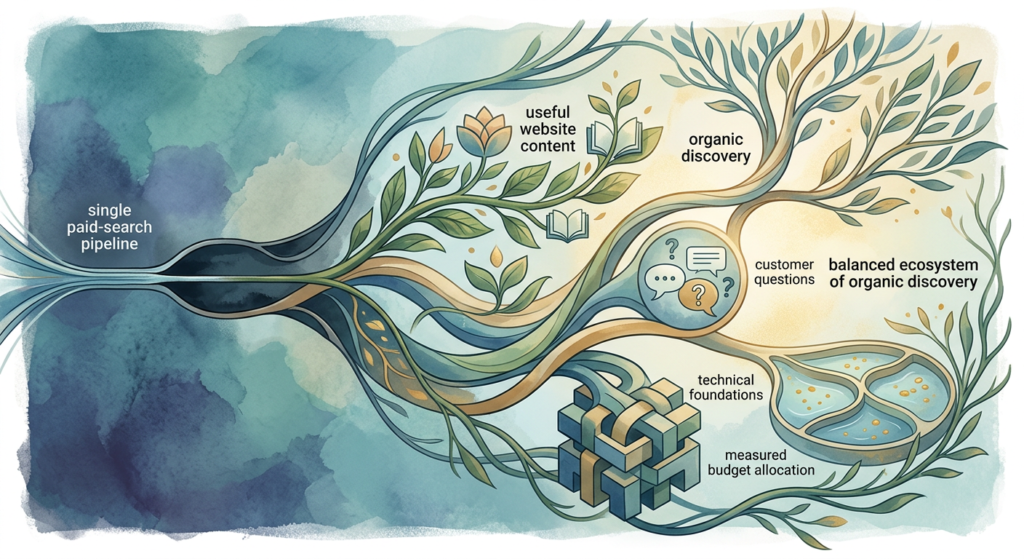
Paid search is often the fastest way to capture existing demand. It can also become an expensive dependency.
The problem is not that paid search works. The problem is what happens when a business relies on it for most non-brand discovery, qualified leads or ecommerce revenue. Costs can rise, competitors can bid more aggressively, platform controls can change and growth can stall as soon as spending is constrained.
Reducing paid-search dependence with organic growth does not mean switching ads off and waiting for SEO to replace them. That is usually reckless. It means building a broader acquisition system in which organic search, direct demand, referrals, answer engines and owned content carry a progressively larger share of discovery and evaluation.
The transition requires sequencing. Organic assets need time to become useful. Paid campaigns should therefore remain active where they provide incremental demand, valuable query data or commercially important coverage.
In my professional judgment, the right objective is resilience rather than an arbitrary organic traffic percentage. A resilient business can moderate paid spend without immediately losing its entire pipeline.
Start by defining what “paid-search dependence” actually means
Channel dependence cannot be diagnosed from traffic share alone. A company may receive 70% of website sessions organically while relying on paid search for most qualified enquiries. Another may appear heavily dependent on ads because paid traffic is high, even though branded campaigns are simply collecting demand created elsewhere.
The diagnosis should examine business outcomes, not just visits.
- Revenue or qualified pipeline concentration: What proportion is attributed to paid search, and how has that changed?
- Brand versus non-brand demand: Are ads creating access to new buyers or mainly capturing people already looking for the company?
- Marginal acquisition cost: What happens to cost per qualified acquisition as spending increases?
- Query concentration: Does performance depend on a small group of expensive commercial terms?
- Landing-page ownership: Does the company have indexable organic pages that satisfy the same needs as its strongest paid campaigns?
- Lead quality: Do paid and organic enquiries progress through the sales process at comparable rates?
Review search-term reports alongside organic query data, CRM outcomes and landing-page performance. The result should be a map of demand: where the business is paying for access, where it already has organic visibility and where neither channel is serving the buyer adequately.
For B2B organisations, this work benefits from explicit intent categories. The framework in Search Intent Mapping for B2B Websites explains how to connect queries with buying stages, page types and commercial priorities.
Do not confuse organic growth with publishing more articles
A common response to rising advertising costs is to commission a large batch of informational content. Volume alone rarely fixes channel dependence.
Organic growth comes from a portfolio of useful, discoverable and commercially connected assets. Depending on the business, that portfolio may include service pages, product or category pages, comparison resources, original tools, buying guides, case evidence, integration pages, location pages and concise answers to recurring customer questions.
Each asset should have a defined job.
| Asset type | Primary job | Useful evidence |
|---|---|---|
| Commercial landing page | Capture active demand for a service, product or use case | Clear scope, process, eligibility, pricing context and proof |
| Problem or educational guide | Help buyers understand an issue before selecting a solution | First-hand analysis, examples, decision criteria and limitations |
| Comparison or alternative page | Support evaluation between plausible choices | Transparent trade-offs and suitability by scenario |
| Case evidence | Reduce perceived risk | Method, context, constraints and verifiable outcomes |
| Answer-focused resource | Provide a concise response that search and answer systems can interpret | Direct answer, supporting detail, definitions and clear sourcing |
The strongest organic programmes connect these page types. An educational article can introduce a problem, link to a relevant service page and provide enough evidence for a buyer to continue. A service page can answer commercial questions directly while pointing to deeper supporting material.
This is not a licence to force every article into a sales pitch. It is an argument for designing a coherent buyer journey rather than producing disconnected traffic assets.
Prioritise demand that paid search has already validated
Paid-search data can reduce some of the uncertainty in an organic roadmap. Search terms, conversion rates, sales outcomes and landing-page behaviour reveal which themes deserve closer investigation.
Start with queries that meet three conditions:
- They express a relevant problem, service or buying need.
- They have produced qualified outcomes, not merely cheap clicks.
- The website lacks a strong, indexable page that directly satisfies the intent.
This does not mean copying an ad-group structure into the website. Paid accounts often contain narrow keyword divisions created for bidding control. Organic pages need to reflect distinct user needs. Several closely related paid terms may belong on one substantial page; apparently similar terms may require separate pages when the expected solution differs.
Use paid data as directional evidence, then validate it with search results, customer language, sales-call themes and existing site performance. Google’s Search Central documentation is a useful reference for technical eligibility and search guidance, while Bing Webmaster resources provide another view of crawling and search performance. Neither source can tell you which commercial topic matters most to your particular business.
Build the organic foundation before reducing spend
Fix access, indexation and page duplication
Content investment is weakened when search engines cannot reliably access important pages or when several URLs compete for the same intent. Check crawl paths, canonical signals, redirects, internal links, rendering, sitemaps and accidental noindex rules.
Prioritise technical work by expected business impact. A minor issue on an isolated article should not outrank an indexation problem affecting core service or category pages.
Strengthen commercially important pages
Many websites send paid traffic to conversion-focused landing pages that are unsuitable for organic discovery. They may be thin, duplicated, blocked from indexation or detached from the main site architecture.
Decide whether each high-value intent needs an enduring organic page, a campaign-only page or both. An organic commercial page generally needs more context than an ad landing page: who the offer is for, what it includes, how it works, key trade-offs, evidence, frequently asked questions and a credible next step.
Create supporting topic coverage
Supporting content should resolve the questions that appear before and during a purchasing decision. Useful sources include sales calls, proposal objections, customer support logs, on-site searches, paid search terms and product-team interviews.
The objective is not to cover every imaginable keyword. It is to demonstrate practical depth around the problems the business genuinely solves.
Install deliberate internal linking
Internal links help users move from research to evaluation while indicating relationships between pages. New supporting resources should link to the most relevant commercial destination. Core pages should link back to useful explanations where buyers need more detail.
A repeatable approach is preferable to occasional manual clean-ups. See Internal Linking Systems That Scale for a structured operating model.
Improve conversion quality as well as visibility
Replacing paid clicks with organic visits is not progress if the resulting enquiries are irrelevant. Review calls to action, forms, qualification language, proof, mobile usability and the continuity between query intent and page content.
Measure deeper outcomes where possible: marketing-qualified leads, accepted opportunities, completed purchases, retained customers or another event that represents business value. Form submissions alone can disguise a substantial quality problem.
Design content for conventional search and answer engines
Organic discovery is no longer limited to a list of blue links. Search features and AI-mediated answer experiences may summarise information, recommend further research or satisfy part of a query without a website visit.
The practical response is not to write mechanically for machines. It is to make important information easier to identify, interpret and verify.
- Answer the central question early, then add context and exceptions.
- Use descriptive headings that correspond to real sub-questions.
- Define ambiguous terms rather than assuming shared knowledge.
- Separate facts, estimates and professional judgment.
- Include original experience, methods or first-party evidence where it genuinely improves the answer.
- Keep company, service and author information consistent across the site.
- Update pages when products, processes or market conditions change.
Answer engine optimisation is an extension of sound information design, not a guaranteed inclusion tactic. Visibility may take the form of a citation, a brand mention, a direct visit or influence that conventional analytics cannot observe.
Use paid and organic search as a coordinated system
Paid search should not be treated as an enemy of organic growth. During the transition, it has at least four useful roles.
- Demand protection: Maintain coverage where organic visibility is weak or volatile.
- Message testing: Test propositions and landing-page language before applying lessons to permanent pages.
- Query intelligence: Identify emerging language, irrelevant demand and high-quality commercial themes.
- Controlled experimentation: Reduce bids or budgets in selected segments to assess whether organic traffic and total conversions compensate.
Budget reductions should happen by query group, location, device, audience or campaign—not as a single account-wide cut. Start where organic coverage is established, conversion tracking is credible and the downside is manageable.
Watch total search outcomes rather than celebrating a lower paid bill in isolation. A saving is not valuable if qualified pipeline falls by more than the saved media and operating cost can justify.
A phased operating plan
Phase 1: establish the baseline
Connect advertising, analytics, search performance and CRM data. Separate brand from non-brand activity. Identify the landing pages, queries and campaigns producing qualified outcomes. Record current paid share, organic share, acquisition cost and lead progression.
Phase 2: close foundational gaps
Resolve high-impact technical issues, improve priority commercial pages and establish internal linking. Fix measurement before publishing at scale. Otherwise, the team may create more activity without learning which work changes business outcomes.
Phase 3: build topic and decision coverage
Publish or improve assets around validated problems, use cases, comparisons and customer questions. Distribution matters: involve sales teams, customer success, email and relevant partners rather than expecting search engines to discover value unaided.
Phase 4: test budget reallocation
Run controlled reductions where organic performance appears capable of carrying more demand. Compare total qualified outcomes with an appropriate prior period or test group, accounting for seasonality and major commercial changes.
Clean testing is difficult but worthwhile. The principles in SEO Experiments With Clean Measurement can help teams distinguish a plausible effect from routine variation.
Executive dashboard example: from reporting to decisions
An executive dashboard should show whether channel risk is falling without hiding deterioration in total demand. The following is a hypothetical example for a B2B service company. Its targets are illustrative management thresholds, not external benchmarks.
| KPI | Definition | Illustrative target | Decision outcome |
|---|---|---|---|
| Paid share of qualified opportunities | Paid-search qualified opportunities divided by all qualified opportunities | Reduce from a 68% baseline to 58% over two quarters | If total opportunities remain stable, continue selective reallocation; if they fall materially, pause cuts |
| Non-brand organic qualified opportunities | CRM-qualified opportunities whose first recorded session was non-brand organic search | Increase 20% from the trailing 90-day baseline | Invest further in page groups producing accepted opportunities |
| Blended search acquisition cost | Paid media plus attributable SEO operating cost divided by qualified search acquisitions | Improve by 10% without reducing sales acceptance rate | Reallocate only when efficiency and quality move together |
| Priority intent coverage | Validated commercial intent groups served by an indexable, quality-reviewed page | Cover 18 of 20 agreed priority groups | Do not cut corresponding campaigns while critical page gaps remain |
| Sales acceptance rate by channel | Accepted opportunities divided by submitted qualified leads | Organic rate stays within five percentage points of the paid rate | Investigate targeting or qualification if organic volume rises but acceptance falls |
A useful dashboard ends with actions. For example: maintain paid coverage for three high-value intents, reduce bids for five intents with stable organic visibility, refresh two pages with declining conversion quality and investigate a tracking break affecting CRM source data.
That is more useful than a monthly slide stating that organic traffic increased. For a broader model, see Digital Marketing Dashboards Executives Can Use.
Measurement limitations to state explicitly
No dashboard provides a complete account of how search influences revenue. Attribution models assign credit according to rules; they do not reconstruct every buyer interaction. Cookie restrictions, consent choices, cross-device journeys, offline conversations and CRM errors create gaps.
Organic and paid channels also interact. An ad may introduce the company before an organic return visit, while content may create familiarity before a branded paid click. Brand campaigns can make paid performance look stronger by collecting demand generated through other activity.
AI and answer-engine visibility adds further uncertainty. Interfaces, citations and referral behaviour vary, and some influence produces no measurable click. Treat visibility measures as directional evidence rather than a substitute for qualified pipeline, revenue or first-party customer research.
Automation can consolidate data, flag anomalies and classify search terms, but it should not make budget decisions without review. Tracking failures can look like performance changes. Query classifications can be wrong. CRM stages may be applied inconsistently.
Document known gaps on the dashboard. Use ranges where precision is unsupported, annotate campaign or tracking changes and periodically audit source data against real sales records. This is less visually tidy than false certainty, but far more useful.
Common mistakes that prolong dependence
- Cutting paid spend before organic pages mature: This creates a demand gap rather than an efficient transition.
- Optimising for traffic alone: High-volume informational visits may have little relationship with qualified demand.
- Publishing duplicate intent pages: More URLs can fragment relevance and increase maintenance.
- Ignoring brand and non-brand splits: Combined reporting conceals whether a channel is generating discovery or collecting existing demand.
- Treating SEO as free: Strategy, content, engineering, design, review and maintenance all have costs.
- Stopping when rankings improve: Visibility is an intermediate indicator, not the business outcome.
Frequently asked questions
How long does it take to reduce paid-search dependence?
There is no dependable universal timeframe. It depends on technical condition, competition, existing authority, content quality, sales cycles and execution capacity. Plan around milestones—coverage, qualified organic demand and successful budget tests—rather than a promised ranking date.
Should brand campaigns be switched off when organic rankings are strong?
Not automatically. Test the incremental value by market and device while considering competitor ads, message control and campaign cost. A controlled test is more informative than a blanket rule.
Can SEO fully replace paid search?
Sometimes organic search can carry most demand for a segment. In other cases, ads remain useful for launches, competitive categories, geographic expansion and queries where organic results are crowded. The appropriate mix is commercial, not ideological.
What should a small team do first?
Identify the handful of non-brand paid themes producing qualified business, improve the corresponding organic pages, fix serious technical barriers and measure CRM outcomes. Depth on validated demand usually beats a large, unfocused publishing calendar.
Conclusion: reduce risk in controlled increments
Reducing paid-search dependence with organic growth is a portfolio and operating-model decision. Diagnose where paid media is genuinely creating value, build durable pages around validated demand and connect visibility to qualified outcomes.
Do not set a ceremonial date to “replace PPC.” Set decision thresholds. When a priority intent has credible organic coverage, stable qualified performance and clean enough measurement, test a selective reduction. Keep spend where it remains incremental. Reinvest proven savings in content maintenance, technical improvements, conversion quality and first-party evidence.
The specific goal is not more organic sessions. It is a search acquisition system that can withstand cost inflation, platform changes and budget pressure without losing access to the customers the business is equipped to serve.